
How to Build Work That Holds in a Distracted Market
Why the algorithm isn’t your problem and what is

🧭 Co-Pilot Navigation: Platform Reality — understanding the systems you’re building within so you don’t mistake distribution for identity.
The Algorithm Is Not a Gatekeeper. It Is Not a Machine With Opinions About Your Potential.
We have spent a great deal of time examining what the market does wrong: the theatrics, the manufactured urgency, the defensive pivots to hierarchy when scrutiny arrives. That examination is necessary. But there is a mirror in this room, and it has been facing the wrong direction.
Because the same distortions that corrupt sellers also corrupt builders who have never sold a thing. And until we name them, they will keep masquerading as strategy.
The algorithm is not your enemy. But it has been a remarkably effective mirror. And most people do not like what they see, so they blame the glass.

What You Are Actually Competing Against
It is not other creators. That framing is too small, and it keeps you in a scarcity posture that poisons everything downstream.
What you are actually competing against is the collapse of attention itself. A distracted age. A feed engineered for amnesia. Every post you make enters a stream designed to make it forgotten.
That is the actual problem. Not the person in your niche who started six months after you and already has more subscribers. Not the algorithm update that came without warning. Not the platform that keeps changing the rules. Those are real friction points, but they are not the structural problem.
The structural problem is that attention is expensive and the market is flooded with people trying to steal it cheaply.
And cheap works for a moment. Loud hooks, borrowed frameworks, templated urgency, these things move. But they do not build. And the people who confuse movement with momentum are the same people who wonder, eighteen months in, why their audience does not trust them with anything that costs real money or requires real change.
You are not trying to win a scroll. You are trying to earn a return visit. Those are different games, and most people are playing the wrong one.
The Deeper Dishonesty
Here is what no one in this conversation wants to say out loud: a great deal of content that presents itself as service is actually a petition.
It is asking for something while dressed as giving something. The language of generosity is there: the tutorials, the breakdowns, the “I just want to help” framing, but underneath it is a quiet desperation for validation that the creator has not yet given themselves.
And audiences feel that. Not in a mystical way. In a very practical, human way. When someone is performing value instead of transmitting it, the energy lands differently. There is a hollow quality to it. The same quality you feel when someone is being nice to you because they want something. You cannot always name it, but you can always sense it.
This is why conviction matters more than craft. This is why someone with less technical skill can build more loyalty than someone with a perfect setup and empty intentions. The signal that travels furthest is not polish. It is genuine belief in what you are saying, combined with genuine care for the person you are saying it to.
When both of those are present, the work carries weight. When either is absent, the work carries noise.
And there is already too much noise.
The Victim Architecture
There is a content posture that has become so normalized that most people who use it do not recognize it as a posture at all. It sounds like frustration, like transparency, like relatability. It says things like:
Nothing I post ever works. The algorithm is suppressing me. I’ve been at this for years and I’m still invisible. I don’t understand why people with less skill are getting more reach.
That frustration is real. But the way it gets packaged and performed is not vulnerability. It is venting dressed as content. And it does something structurally destructive to your brand: it signals that you do not have agency over your own work.
Discernment asks: what is not landing, and why?
Victimhood answers: the system is broken, and I am the proof.
One of those questions leads somewhere. The other is a loop.
The hard truth is that the algorithm is not suppressing you. People are scrolling past you. That distinction is not semantic, it is everything.
Because if the algorithm is the problem, you are powerless. But if people are scrolling past you, that is information. That is feedback. That is a question you can actually answer.
The question is whether you want to answer it or whether you want an enemy. Both are available. Only one of them builds anything.
On Borrowed Packaging
Here is a pattern worth examining in your own work: when you create something, where does the structure come from?
Did it come from what you actually understand, what you have actually lived, what you have genuinely worked through? Or did it come from reversing a format you saw perform well, plugging your content into a template, and hoping the architecture would carry the weight of the substance?
Templates are not inherently dishonest. Structure exists for a reason, and studying what works is part of the craft. But there is a difference between learning the principles behind what works and copying the container without understanding what fills it.
When you borrow the packaging without owning the substance, the audience senses the gap. Not consciously, perhaps. But the content does not land the way it should. It informs without imprinting. It gets watched but not saved. It performs without converting. And you are left refreshing analytics wondering what went wrong, when what went wrong was present from the first line of the script.
You cannot import authority. You can only build it.
And you build it from what is actually yours: your specific experience, your specific framework, your specific failures and the reasoning you developed in response to them. That combination belongs to no one else. It is the only content that cannot be replicated, because it cannot be separated from the person who built it.
The Question of Depth
Shallow content is not a content problem. It is a foundation problem.
If you are struggling to say something with weight, it is almost always because one of three things is missing: enough time sitting with the idea before packaging it, enough honest reflection to know what you actually believe rather than what sounds credible, or enough commitment to your own perspective to hold it under scrutiny.
Depth is not complexity. It does not require longer videos or more elaborate frameworks. Depth is the feeling that someone thought this through before they said it. That they are not performing discovery, they are reporting from somewhere they have actually been.
And this is where exploration becomes essential, not as a content strategy, but as a practice. The creators who say things that have not been said are not more intelligent than the ones repeating familiar frameworks. They are more curious. They spend time in questions before moving to answers. They are willing to be uncertain in private so they can be clear in public.
The market is full of people with answers. It is starving for people with honest questions.
That willingness to ask what is missing rather than what is working is the single most differentiating posture available to a creator right now. And it costs nothing except the willingness to sit still long enough to actually think

What Governed Creation Looks Like
It is quieter than the algorithm rewards, at least at first. It does not trend in the first week. It does not spike. It does not invite outrage or manufactured urgency or the kind of compression that makes people feel like they have to decide right now.
What it does is compound.
The person who finds it at month three returns at month nine. The video that earned three hundred views in the first week gets found by the right person two years later and changes something in them. The content that was built from something real keeps doing work long after the trend it could have chased has gone.
Governed creation means you know what you are building before you open the camera. It means the measure of a post is not whether it performed, but whether it was true to the thing you are actually trying to say. It means you have separated your identity from your metrics, so a slow month is data, not a verdict.
It means when someone challenges your work, you can explain it. Not defend it. Not perform above it. Explain it. Break it down. Show the thinking. Because you were thinking when you built it, not just producing.
The Standard, Continued
Structure is the antidote to both distortions. The distortion that sells noise and the distortion that performs suspicion. Neither requires you to build anything real. Both are reactions. Both are loud. And both will eventually exhaust the person performing them, because there is no foundation underneath.
What you are building, if you are building honestly, is something that can hold weight. Something that can withstand a question without flinching. Something that does not need to perform authority because it has actually developed it.
That does not happen through a better hook. It does not happen through a more emotional thumbnail or a smarter post schedule or a more aspirational feed. It happens through the unglamorous work of knowing what you believe, why you believe it, who you built this for, and what it actually does.
When that is clear, everything else is just distribution.
The Navigation Notebook
This is exactly why I built the standard I hold myself to inside The Navigation Notebook. Not a content calendar. Not a posting strategy. Not a formula for going viral.
Structure.
Because the problem most creators have is not that they lack ideas. It is that they lack a foundation stable enough to build on when the pressure hits. When the metrics dip. When a competitor launches something that looks adjacent to your work. When doubt arrives and the algorithm feels indifferent and the effort stops feeling worth it.
Without structure, those moments govern you. You react. You pivot. You start rewriting the offer every time someone else’s launch gains traction. You start softening your message every time a comment stings. You start performing confidence because you have not yet built it.
The Navigation Notebook exists to change that. It forces you to:
Define what you are actually building before the noise has a chance to redefine it for you
Separate conviction from ego so you can take feedback without collapsing and hold your position without becoming defensive
Install decision criteria before pressure hits so when criticism comes, you don’t spiral, you refer back to what you already decided, on a clear day, before anyone was watching
You stop chasing the algorithm because you already know what you are building and who it is for. You stop performing authority because you have done the work to actually develop it. You stop reacting to the market and start responding from something more stable than a feeling.
That is the difference between a creator who lasts and one who burns out performing.
The noise will continue. The market will stay saturated. Your job is not to be louder than it. Your job is to be so structurally clear that the noise simply does not reach you the way it used to.
That is what governed looks like. And that is the standard The Navigation Notebook is built to install.

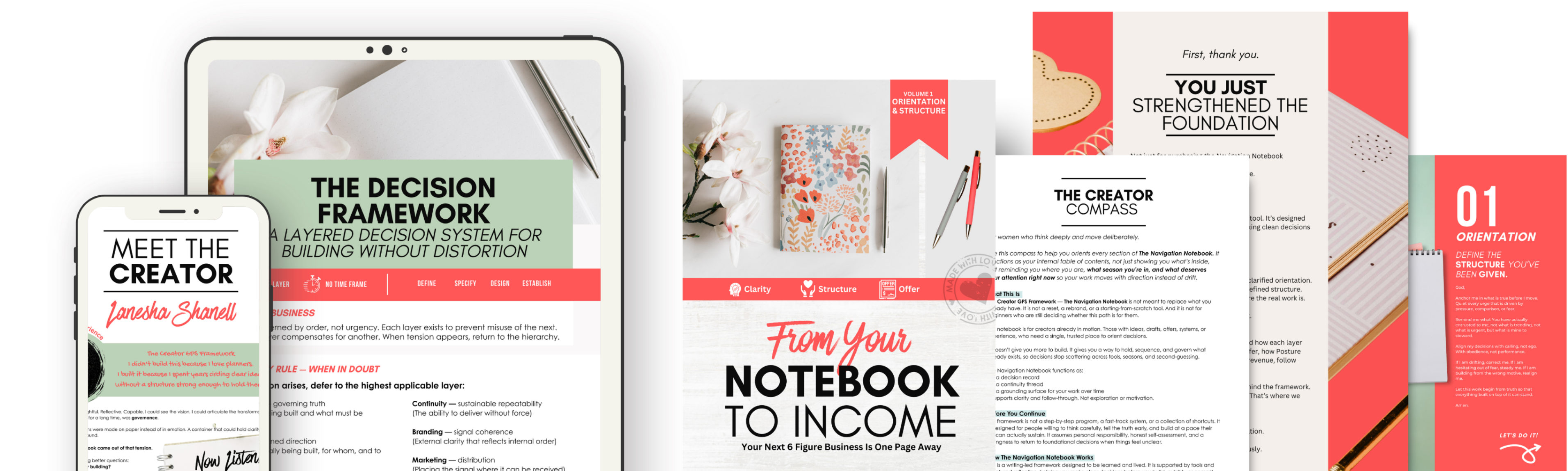

A 90-day governance journal for the faith-led woman who is ready to turn what God gave her into something that actually reaches people and sustains her family.
12 sections · 30–90 days · digital download
On That Note:
Am I being redirected? Or am I simply uncomfortable? If God has not said move, it is time to stay.
Take what helps. Leave what doesn’t. Return when clarity, not urgency, is what you’re looking for.
The Creator GPS™ by Lanesha Shanell
Leading what I’ve been given, in structure and stewardship.
